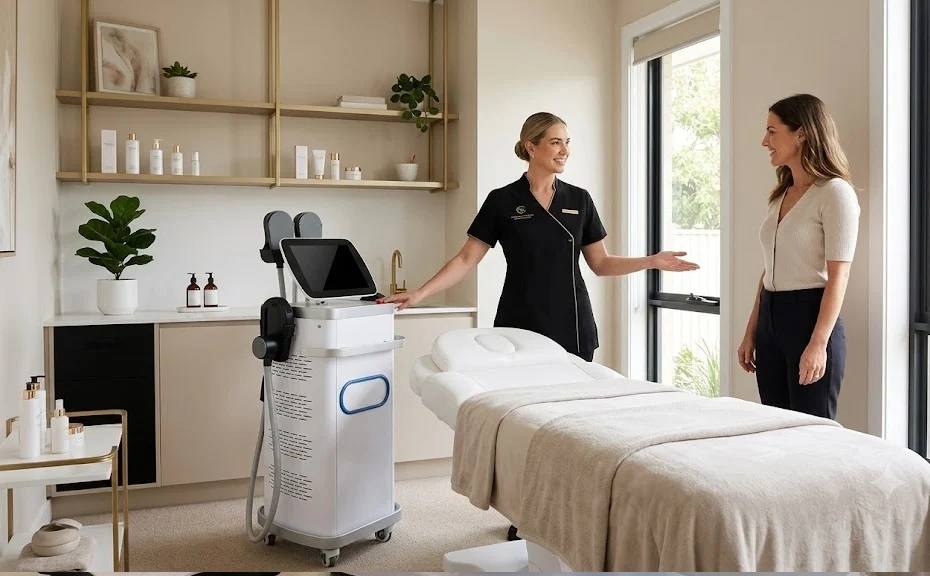
Starting a home body contouring business can offer a practical pathway into the beauty and aesthetics industry without the rent, staffing costs and long lease commitments associated with opening a commercial clinic.
A professionally presented home studio can allow you to:
- Build a business gradually
- Work flexible hours
- Keep fixed operating costs relatively low
- Offer private one-on-one appointments
- Develop a loyal local client base
- Sell structured treatment programs
- Expand into a commercial clinic later if demand supports it
HIEMT is particularly attractive for a home-based business because it can provide a premium, non-invasive body-toning service with relatively few treatment consumables.
A professional HIEMT machine uses high-intensity electromagnetic energy to stimulate powerful, repeated muscle contractions in a selected treatment area. Depending on the intended purpose of the specific device, HIEMT may be used to support muscle tone, firmness, strength and body-contouring goals.
It is not a general weight-loss treatment, and it should not be promoted as a replacement for exercise, physiotherapy, medical care or a balanced lifestyle.
Starting a successful home body contouring business involves far more than purchasing a machine and creating an Instagram page. You need to consider:
- Council and planning requirements
- Business registration
- Insurance
- Equipment selection
- Training
- Treatment-room suitability
- Client screening
- Consent and record keeping
- Hygiene
- Pricing
- Package terms
- Advertising
- Cash flow
- Client acquisition
- Risk management
This guide explains each stage of starting a home HIEMT business in Australia, from checking whether clients can legally visit your property to calculating treatment earnings and launching your first packages.
Explore HIEMT Equipment and Training
- View professional HIEMT machines
- Complete the accredited HIEMT Toning Online Course
- Complete the accredited Body Sculpting Online Course
- View all body sculpting training courses
- Browse all professional beauty equipment
What Is a Home Body Contouring Business?
A home body contouring business provides non-surgical aesthetic treatments from a treatment room located within or associated with the operator’s residence.
The treatment space might be:
- A converted bedroom
- A dedicated room near the entrance
- A converted garage
- A detached studio
- A granny flat
- A purpose-built treatment room
- Another area approved for business use
The business remains home-based even though clients attend the property.
This distinction matters because running a client-facing business from home can affect:
- Planning approval
- Parking
- Traffic
- Signage
- Noise
- Building classification
- Fire safety
- Insurance
- Rental agreements
- Body corporate or owners corporation rules
- Home-loan conditions
- Capital gains tax considerations
- Neighbour relations
The Australian Government notes that a home-based business generally requires the same core business and tax registrations as another business and may also require council approval, licences, permits or landlord approval.
Do not assume that a spare room automatically becomes a lawful commercial treatment room.
Why HIEMT Can Suit a Home-Based Business
Premium Appointment Value
Home salons often have limited daily appointment capacity.
This makes the value of each booking important.
A home operator who charges $30 or $40 for a short service may need a large number of clients to generate sustainable revenue. HIEMT can potentially be positioned as a higher-value professional service, particularly when sold as a structured treatment program.
A home clinic may offer:
- Individual HIEMT sessions
- Four-session programs
- Six-session programs
- Multi-area packages
- Maintenance appointments
- Body-toning memberships
- Consultation and treatment bundles
Pricing must reflect the operator’s qualifications, equipment, local market and treatment experience. A home address does not mean the service needs to be positioned as cheap.
Clients are paying for:
- Access to professional equipment
- A personalised consultation
- Practitioner knowledge
- Treatment planning
- Time in the treatment room
- Privacy
- Progress monitoring
- Professional follow-up
- Convenience
Limited Treatment Consumables
HIEMT appointments generally require fewer high-cost consumables than treatments relying on cartridges, single-use heads, needles or specialised serums.
The business will still need supplies such as:
- Cleaning and disinfection products
- Disposable bed protection
- Towels
- Protective barriers where required
- Laundry supplies
- Consultation paperwork
- Photography supplies
- General treatment-room products
However, the cost consumed during each treatment may remain relatively low.
This can support a strong contribution margin after the major equipment investment has been made.
Repeat Treatment Programs
HIEMT is generally offered as a series rather than as a once-only experience.
The exact treatment frequency and recommended program should always follow:
- The machine instructions
- Model-specific training
- Client assessment
- Insurer requirements
- The intended purpose of the equipment
Treatment programs can benefit a new home business because they encourage:
- Repeat appointments
- Upfront package payments
- Greater client commitment
- Progress reviews
- Maintenance bookings
- Referrals
- More predictable revenue
Broad Consumer Appeal
HIEMT can potentially appeal to:
- Women seeking abdominal or gluteal toning
- Men interested in abdominal or arm definition
- Fitness clients
- Busy professionals
- Existing body contouring clients
- Mature clients interested in maintaining tone
- Clients preparing for a holiday, wedding or event
- People seeking a non-invasive body treatment
Your advertising should remain inclusive and avoid presenting one body type as the only acceptable standard.
Privacy and Personal Service
Some clients prefer a quiet home studio to a busy shopping-centre salon.
A home clinic can provide:
- Private arrival and departure
- One practitioner
- Minimal waiting
- No crowded reception area
- Discreet treatment
- A consistent treatment experience
This can become an important point of difference when the space is professional, clean and clearly separated from ordinary household activity.
Step 1: Decide Whether a Home Business Is Right for You
Before purchasing a HIEMT machine, consider whether your home and lifestyle are suited to receiving clients.
Ask yourself:
- Is there a separate room available?
- Can clients enter without walking through private family areas?
- Is there suitable parking?
- Will appointments disturb neighbours?
- Are pets able to be kept completely away from the clinic?
- Is there access to a toilet and handwashing facilities?
- Can the machine be moved safely into the room?
- Is the electrical supply suitable?
- Is there adequate ventilation or cooling?
- Can client information be stored securely?
- Can deliveries arrive without creating household disruption?
- Will family members respect appointment privacy?
- Can the room remain professionally presented every day?
- Is there space for consultation, treatment and changing?
- Can you afford the equipment if bookings grow slowly?
A home business can reduce rent, but it does not eliminate business pressure.
The operator still needs to generate enough revenue to cover:
- Equipment payments
- Insurance
- Marketing
- Electricity
- Cleaning
- Laundry
- Booking software
- Merchant fees
- Website costs
- Training
- Accounting
- Maintenance
- Tax
- Personal income requirements
Step 2: Check Council and Planning Requirements Before Buying Equipment
Council rules differ between locations.
A home business that is permitted without formal approval in one council area may require planning approval in another.
The requirements may depend on:
- Number of clients attending each day
- Number of employees
- Hours of operation
- Parking demand
- Signage
- Noise
- Floor area used
- Whether the business changes the residential character of the property
- Whether alterations are required
- Whether clients wait outside
- Whether equipment or stock is stored onsite
- Whether the property is in a bushfire, flood or heritage area
- Whether the treatment use has special health requirements
Business.gov.au advises that home businesses may require licences, permits, landlord approval and council approval.
Some councils permit small-scale beauty services as home-based activities where specified conditions are met, but the conditions are local and should never be assumed. For example, Brisbane’s home-business requirements recognise small-scale beauty and hairdressing services as examples of home-based activity, but operators must still determine whether their proposed use meets the applicable requirements.
Contact Your Council in Writing
Provide the council with an accurate description of the proposed business.
Explain:
- The service is non-surgical
- Whether the skin is penetrated
- The equipment you will use
- Expected appointment duration
- Maximum clients per day
- Proposed hours
- Whether you will employ anyone
- Available onsite parking
- Proposed signage
- Whether building work is required
- The room or outbuilding that will be used
Ask for written guidance on whether you need:
- Planning approval
- Development approval
- Building approval
- Health registration
- A home-occupation permit
- Signage approval
- Additional parking
- A change of use
- Fire-safety upgrades
- An inspection
Keep the response with your business records.
Do Not Describe the Service Vaguely
Terms such as “wellness,” “consulting” or “online business” may produce an incorrect answer if clients will actually attend for machine-based body treatments.
Be transparent about the service.
Step 3: Check Your Property Arrangements
Renting
A tenant may need written permission from the landlord or property manager before operating a business or allowing clients to attend.
Check:
- Your residential lease
- Business-use restrictions
- Insurance conditions
- Parking
- Signage
- Alteration rules
- Whether commercial activity is prohibited
Do not rely on verbal permission.
Apartments, Townhouses and Strata Properties
Check the rules of your:
- Body corporate
- Owners corporation
- Strata scheme
- Community title
- Building management agreement
Rules may address:
- Commercial activity
- Client access
- Visitor parking
- Signage
- Noise
- Security
- Use of common property
- Deliveries
Even when council approval is not required, body corporate rules may still restrict the activity.
Mortgaged Property
Review whether using part of the property for business affects:
- Your home insurance
- Mortgage conditions
- Refinancing
- Property valuation
- Tax treatment
An accountant can advise on the potential tax consequences of claiming occupancy expenses or using a dedicated part of the home as a place of business.
The Australian Taxation Office provides separate guidance on deductions for home-based business expenses and distinguishes between running expenses and occupancy expenses.
Step 4: Choose a Business Structure
The common options include:
- Sole trader
- Partnership
- Company
- Trust structure
Sole Trader
A sole trader structure is usually the simplest and least expensive to establish.
The owner controls the business but is personally responsible for its debts, losses and legal obligations.
A sole trader may suit someone who:
- Is beginning alone
- Has a relatively simple operation
- Wants low setup costs
- Does not initially employ staff
- Has obtained professional advice about personal liability
Company
A company is a separate legal entity.
It may suit a business that:
- Plans to employ staff
- Expects to expand
- Will bring in investors or other owners
- Wants a structure separated from the individual
- Has received accounting and legal advice supporting incorporation
A company has additional costs, reporting duties and director obligations. Australian companies must be registered through ASIC.
Get Professional Advice
A company does not automatically remove every personal risk, and a sole trader is not always the wrong choice.
Discuss the structure with:
- An accountant
- A registered tax agent
- A commercial lawyer where appropriate
Step 5: Register the Business
Australian Business Number
An ABN is the identifying number used for business dealings with government, suppliers and clients.
ABN registration is free through the Australian Government’s Business Registration Service. An ABN can be used for invoicing, GST registration and registering an Australian domain name.
Business Name
You need to register a business name if you trade under a name other than your own personal name.
ASIC explains that a business name is the name under which a business operates and must generally be registered when it is not simply the owner’s own name.
Before choosing a name:
- Search the ASIC business-name register
- Search Australian trademarks
- Check domain availability
- Check social media names
- Search Google
- Avoid names suggesting medical qualifications you do not hold
- Avoid names that are too similar to established competitors
Registering a business name does not give the same protection as registering a trademark.
GST
Businesses generally need to register for GST when their current or projected GST turnover reaches $75,000. Voluntary registration may be available below that threshold.
GST turnover is not the same as profit.
A clinic can reach the threshold even if significant amounts are spent on equipment, finance, advertising and other expenses.
Seek accounting advice before setting package prices. A business that sets prices without allowing for GST may lose part of its expected margin once registration becomes compulsory.
Step 6: Arrange the Right Insurance
A standard home-and-contents policy may not cover:
- Paying clients
- Business equipment
- Professional treatment claims
- Business interruption
- Client injury
- Stock
- Data loss
- Commercial legal liability
Tell your home insurer that you intend to operate a client-facing body contouring business.
Business.gov.au identifies several business insurance categories and notes that sole traders are not covered by workers compensation for their own injury or illness.
Insurance to Discuss With a Broker
Professional Indemnity
This may respond to claims relating to professional advice, treatment or alleged practitioner error.
Public Liability
This may respond where a client or visitor suffers injury or property damage, such as slipping on a path or tripping in the treatment room.
Product Liability
This may be relevant if you supply or recommend products.
Business Equipment Cover
Confirm that the HIEMT machine is covered at the home address and during delivery, servicing or transport where applicable.
Business Interruption
This may assist with certain insured interruptions that stop the business operating.
Cyber and Data Cover
This may be relevant if you store:
- Medical histories
- Consent forms
- Photographs
- Payment information
- Contact details
Personal Accident and Income Protection
A sole trader may need separate protection if illness or injury prevents them from working.
Obtain Written Confirmation for HIEMT
Do not ask only whether the insurer covers “beauty treatments.”
Ask the insurer to confirm in writing that the policy covers:
- HIEMT
- Electromagnetic muscle stimulation
- Body contouring
- Every other technology you provide
- The home business address
- Your qualifications
- Any employees or contractors
- The particular treatment areas
- The equipment model where required
Keep the confirmation with your policy documents.
Step 7: Complete Professional HIEMT and Body Contouring Training
Purchasing a machine does not qualify someone to operate it safely.
Training should cover:
- HIEMT principles
- Relevant muscle anatomy
- Treatment mechanisms
- Client consultation
- Contraindications
- Medical history
- Implant screening
- Treatment areas
- Applicator placement
- Intensity adjustment
- Treatment scheduling
- Hygiene
- Treatment records
- Consent
- Photography
- Aftercare
- Adverse reactions
- Referral for medical clearance
- Scope of practice
- Ethical marketing
Beauty Equipment Direct offers an accredited HIEMT Toning Online Course and broader body sculpting training designed to support beauty professionals entering this treatment category.
Recommended Training
- HIEMT Toning Online Course
- Body Sculpting Online Course
- All body sculpting training courses
- HIEMT Body Toning Printable Manual
- All accredited beauty courses
Confirm that your course and prior qualifications are accepted by your insurer before treating clients.
Step 8: Choose the Right HIEMT Machine
The cheapest machine is not necessarily the least expensive business decision.
Consider:
- Australian regulatory status
- Intended purpose
- Number of handles
- Treatment areas
- Power requirements
- Machine size
- Noise
- Warranty
- Local servicing
- Parts availability
- Training
- Delivery
- Installation
- Technical support
- Supplier history
- Finance cost
- Room suitability
- Expected client demand
ARTG Inclusion and “TGA Approved” Wording
Beauty and equipment businesses often use the phrase “TGA approved.” However, businesses should avoid presenting the TGA as recommending or endorsing equipment.
Where relevant, the more accurate wording is generally:
Included in the Australian Register of Therapeutic Goods for its stated intended purpose.
Ask the supplier for:
- ARTG entry number
- Sponsor name
- Device description
- Intended purpose
- Confirmation that the exact supplied model is covered
- Permitted advertising claims
ARTG inclusion does not allow an operator to make unsupported claims or use the device beyond its intended purpose.
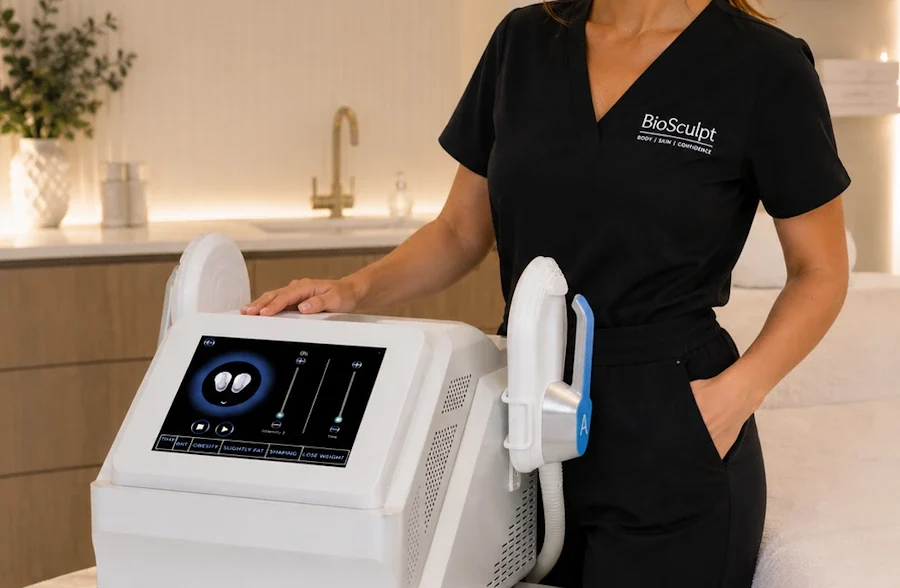
Two-Handle HIEMT Machines
A two-handle machine may suit:
- A sole operator
- A smaller room
- A startup business
- A lower initial budget
- A business expecting modest initial demand
- A clinic primarily treating one paired area at a time
Explore Two-Handle Options
- BioSculpt Body 2 Handle HIEMT
- Professional BioSculpt Body 2 Handle HIEMT
- Premium BioSculpt Body 2 Handle HIEMT
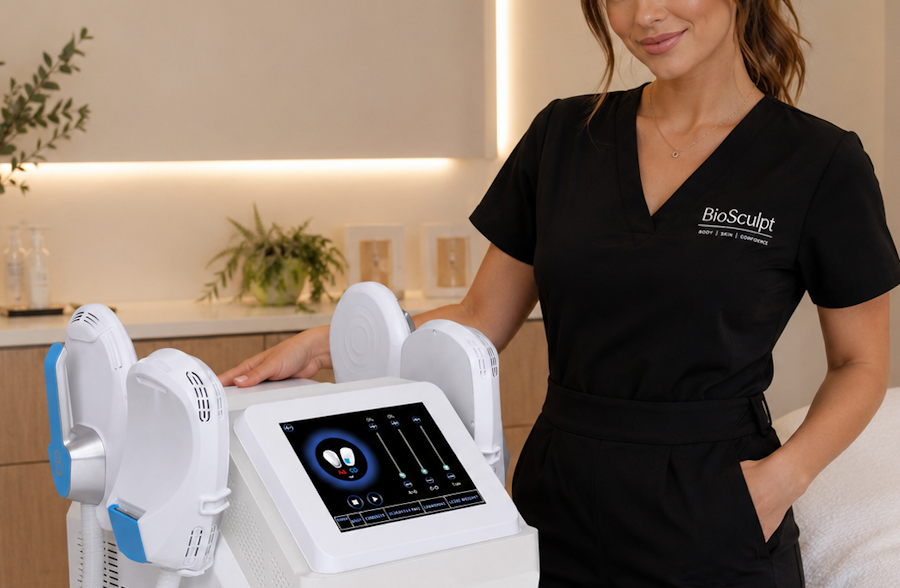
Four-Handle HIEMT Machines
A four-handle machine may suit:
- A higher-volume business
- Multi-area treatment packages
- A larger treatment space
- An operator with an established database
- A clinic expecting several appointments each day
- A business with a larger equipment budget
Explore Four-Handle Options
- BioSculpt Body 4 Handle HIEMT
- Professional BioSculpt Body 4 Handle HIEMT
- Premium BioSculpt Body 4 Handle HIEMT
View the complete HIEMT machine range
Step 9: Design a Professional Home Treatment Room
Your clinic should feel separate from the rest of the home.
Clients should not encounter:
- Household clutter
- Children’s belongings
- Cooking smells
- Pets
- Unwashed laundry
- Personal documents
- Unrelated household activity
- Other family members moving through the room
Essential Treatment-Room Features
Consider including:
- Professional treatment bed
- HIEMT machine
- Operator stool
- Client chair
- Consultation area
- Secure storage
- Lockable client-record storage
- Handwashing access
- Paper towel or suitable hand-drying system
- Covered waste bin
- Cleaning supplies
- Fresh linen storage
- Used-linen container
- Full-length mirror
- Hooks or changing area
- Suitable lighting
- Ventilation or air conditioning
- Electrical outlets assessed for the machine
- Smoke alarm and fire-safety equipment
- First-aid kit
- Emergency contact information
Client Privacy
Provide:
- A door that closes
- Window coverings
- Privacy during changing
- A clear policy on photography
- Secure digital records
- Sound privacy where possible
- Appointments that do not overlap unnecessarily
Access and Safety
Review the path from parking to the treatment room.
Check:
- Steps
- Uneven surfaces
- Wet areas
- Outdoor lighting
- Handrails
- Rugs
- Electrical leads
- Door widths
- Emergency exits
- Wheelchair or mobility access where represented as available
Never advertise the premises as accessible unless it genuinely is.
Step 10: Separate Pets and Household Activity From the Clinic
Pets should not enter:
- The treatment room
- Client waiting areas
- Linen storage
- Product storage
- Cleaning-supply areas during service delivery
Even a friendly pet may create:
- Allergy risks
- Fear
- Hygiene concerns
- Noise
- Trip hazards
- Insurance complications
- An unprofessional impression
The clinic should also have a plan for:
- Deliveries
- Children returning from school
- Household visitors
- Yard maintenance
- Barking
- Family parking
- Personal phone calls
A home salon succeeds when it functions like a clinic during appointment hours.
Step 11: Create Your Startup Budget
The equipment will usually be the largest cost, but it is not the only one.
Illustrative Home HIEMT Startup Budget
| Startup Item | Lean Setup | Professional Setup |
|---|---|---|
| HIEMT machine | $8,000 | $18,000 |
| Training | $300 | $1,500 |
| Insurance | $700 | $1,800 |
| Council or professional fees | $0–$500 | $500–$2,500 |
| Treatment bed and furniture | $700 | $2,500 |
| Room preparation | $500 | $5,000 |
| Linen and hygiene supplies | $300 | $1,000 |
| Computer or tablet | $0–$500 | $1,500 |
| Booking and payment setup | $100 | $700 |
| Branding and signage | $200 | $1,500 |
| Website | $300 | $3,000 |
| Launch marketing | $500 | $3,000 |
| Photography and content | $0–$500 | $2,000 |
| Accounting and legal setup | $300 | $2,000 |
| Working-capital reserve | $2,000 | $8,000 |
| Indicative total | $13,900–$15,900 | $52,000–$54,000 |
These figures are examples only.
Your actual budget may be lower or higher depending on:
- Equipment model
- Existing room condition
- Local approvals
- Finance
- Whether you already own furniture or technology
- Branding
- Marketing
- Professional advice
Keep a Cash Reserve
Do not invest every available dollar in the machine.
Keep funds for:
- Slow initial bookings
- Advertising tests
- Repairs
- Insurance excess
- Refunds
- Electricity
- Accounting
- Consumables
- Personal living costs
- Finance payments
- Unexpected council requirements
Step 12: Understand Equipment Finance
Finance can preserve cash, but it increases total equipment cost.
Before accepting finance, check:
- Deposit
- Interest rate
- Establishment fees
- Monthly payment
- Final balloon payment
- Early repayment fees
- Personal guarantees
- Ownership during the finance period
- Insurance requirements
- Total amount payable
- What happens if the machine cannot be used
- Whether payments remain affordable during a slow launch
Do not calculate affordability using an optimistic fully booked schedule.
Use a conservative booking forecast.
Step 13: Set Your HIEMT Prices
Avoid copying the cheapest competitor.
Your price needs to cover:
- Practitioner time
- Consultation
- Machine use
- Cleaning
- Laundry
- Electricity
- Payment fees
- Advertising
- Insurance
- Training
- Servicing
- Finance
- Administration
- GST where applicable
- Profit
Illustrative HIEMT Pricing
| Service | Example Price |
|---|---|
| Consultation | Complimentary or $49 |
| Introductory session | $129–$169 |
| Standard single session | $180–$250 |
| Four-session program | $680–$880 |
| Six-session program | $960–$1,260 |
| Eight-session program | $1,200–$1,600 |
| Two-area session | $280–$380 |
| Monthly maintenance | $160–$220 |
These figures are not recommended prices for every location.
Research your local market and calculate your costs.
Avoid Excessive Package Discounts
Suppose a single session is advertised at $220.
An eight-session package sold for $960 produces an average of only $120 per session. That may be far below the margin assumed when the business purchased the equipment.
Packages should reward commitment without making the business unsustainable.
Step 14: Calculate Potential Revenue
Revenue is not the same as profit.
The following example assumes:
- Average collected price: $180
- Four trading weeks per month
- All appointments are paid
- No refunds or cancellations
Example Monthly HIEMT Revenue
| Paid Treatments Per Week | Treatments Per Month | Gross Monthly Revenue | Gross Annual Revenue |
|---|---|---|---|
| 5 | 20 | $3,600 | $43,200 |
| 10 | 40 | $7,200 | $86,400 |
| 15 | 60 | $10,800 | $129,600 |
| 20 | 80 | $14,400 | $172,800 |
| 25 | 100 | $18,000 | $216,000 |
These figures do not deduct:
- GST
- Tax
- Wages
- Superannuation
- Marketing
- Insurance
- Finance
- Maintenance
- Utilities
- Payment fees
- Cancellations
- General overhead
Example Home Business Profit Model
Assume:
- 40 paid treatments each month
- Average collected price: $180
- Gross monthly revenue: $7,200
Illustrative monthly costs:
| Expense | Example Monthly Cost |
|---|---|
| Equipment finance | $850 |
| Marketing | $900 |
| Direct supplies and laundry | $400 |
| Merchant fees | $150 |
| Insurance allocation | $120 |
| Booking software and website | $120 |
| Electricity and utilities | $180 |
| Accounting and administration | $250 |
| Maintenance reserve | $200 |
| General expenses | $250 |
| Total operating expenses before tax and owner labour | $3,420 |
Illustrative amount remaining:
$7,200 − $3,420 = $3,780
This is not automatically profit.
The operator must still account for:
- GST where registered
- Income tax
- Their own labour
- Superannuation
- Leave
- Personal insurance
- Unexpected costs
Step 15: Calculate Your Break-Even Point
Assume:
- Machine cost: $14,750
- Average collected treatment price: $180
- Direct variable cost per treatment: $15
- Contribution before fixed overhead: $165
Simplified equipment break-even:
$14,750 ÷ $165 = approximately 90 paid treatments
At ten treatments per week, this represents approximately nine trading weeks.
That does not mean the entire business will become profitable in nine weeks. It ignores marketing, room setup, training, insurance, finance, tax and general overhead.
Conservative Break-Even Scenarios
| Average Collected Price | Estimated Contribution Per Session | Treatments to Cover $14,750 |
|---|---|---|
| $130 | $110 | 135 |
| $150 | $130 | 114 |
| $180 | $160 | 93 |
| $200 | $178 | 83 |
| $220 | $195 | 76 |
Use the contribution from the average treatment actually sold, not the highest advertised price.
Step 16: Create Your Treatment Menu
A new business does not need a long service menu.
A simple menu may convert more effectively.
Example Launch Menu
HIEMT Consultation
Includes:
- Goals
- Medical history
- Contraindication screening
- Treatment explanation
- Suitability assessment
- Photography consent
- Recommended program
- Package options
Introductory HIEMT Session
Suitable for approved new clients who want to experience the treatment before committing to a program.
Four-Session Toning Program
A lower-commitment structured series.
Six-Session Body-Toning Program
A core program based on the machine protocol and client assessment.
Multi-Area Program
For suitable clients seeking treatment across more than one permitted area.
Maintenance Session
Available after completion of an initial program.
Do not offer a package that conflicts with the protocol for your device.
Step 17: Establish a Professional Consultation Process
A consultation protects both the client and the business.
It should document:
- Full name
- Date of birth
- Address
- Contact details
- Emergency contact
- Relevant medical history
- Medication
- Surgical history
- Pregnancy status
- Implants
- Pacemaker or electronic devices
- Metal in or near the treatment area
- Hernia
- Epilepsy or seizure history
- Recent injury
- Recent surgery
- Unexplained pain
- Treatment goals
- Previous body treatments
- Informed consent
- Practitioner assessment
Medical Clearance
Medical clearance may be appropriate where:
- Suitability is uncertain
- The client has a relevant medical condition
- There has been recent surgery
- The client reports unexplained symptoms
- The manufacturer or insurer requires it
A beauty practitioner should not:
- Diagnose a condition
- Promise to treat a medical disorder
- Tell a client to stop medication
- Interpret medical imaging
- Override medical advice
- Treat simply because the client accepts the risk
Step 18: Understand HIEMT Contraindications
The manufacturer’s contraindication list for the exact machine must always take priority.
Potential contraindications or matters requiring further assessment may include:
- Pregnancy
- Suspected pregnancy
- Pacemaker
- Implanted defibrillator
- Electronic implant
- Relevant metal implant
- Recent surgery
- Hernia
- Epilepsy
- Significant cardiac conditions
- Active infection
- Open wounds
- Impaired sensation
- Acute injury
- Active cancer
- Unexplained pain
- Conditions affected by powerful muscle contraction
Non-invasive does not mean suitable for everyone.
Step 19: Prepare Consent Forms and Records
Your client system should include:
- Consultation form
- Contraindication checklist
- Informed consent
- Treatment record
- Photography consent
- Aftercare sheet
- Medical-clearance request
- Adverse-event form
- Package agreement
- Cancellation policy
- Refund policy
- Privacy information
Treatment Records
Record:
- Date
- Treatment area
- Applicator placement
- Program
- Intensity
- Duration
- Client feedback
- Skin or muscle response
- Aftercare provided
- Next appointment
- Any unexpected event
Do not rely on memory.
Step 20: Develop a Hygiene and Cleaning System
Even when the treatment does not penetrate the skin, the clinic still needs professional infection-control and hygiene procedures.
Create written procedures for:
- Hand hygiene
- Cleaning the treatment bed
- Cleaning applicators
- Approved disinfectants
- Contact time
- Barrier use
- Linen
- Waste
- Floors
- High-touch surfaces
- Toilet cleaning
- Equipment storage
- Product storage
- Spill management
Follow the equipment manufacturer’s cleaning instructions. Some chemicals may damage applicator surfaces, plastics or electronics.
Linen System
Separate:
- Clean linen
- Used linen
- Household laundry
- Treatment-room laundry
Do not use the same basket for clean and used linen.
Step 21: Create a Safe Client Journey
The client experience begins before arrival.
Before the Appointment
Send:
- Address
- Parking instructions
- Arrival instructions
- Clothing advice
- Consultation form
- Cancellation policy
- Payment terms
- Preparation instructions
Arrival
The client should know:
- Which entrance to use
- Where to park
- Whether to knock or message
- Whether they may arrive early
- Whether a waiting area is available
During the Appointment
Provide:
- Privacy
- Clear explanations
- Time for questions
- Appropriate positioning
- Ongoing comfort checks
- Professional communication
- No pressure to buy
After the Appointment
Provide:
- Aftercare
- Expected temporary sensations
- Warning signs requiring contact
- Next booking
- Contact details
- Review process
Step 22: Create Honest Before-and-After Photography
Progress photography can help clients evaluate change, but it must be standardised and truthful.
Use consistent:
- Lighting
- Camera
- Distance
- Angle
- Background
- Clothing
- Posture
- Time relative to treatment
- Image cropping
Do not:
- Retouch the body
- Change proportions
- Use different poses to exaggerate change
- Alter lighting dramatically
- Ask clients to inhale in one image and relax in another
- Use stock photos as your work
- Publish without written consent
State that individual results vary.
Step 23: Build Your Brand
A strong home-clinic brand should communicate:
- Professionalism
- Privacy
- Trust
- Cleanliness
- Education
- Realistic outcomes
- Personalised service
Choose a Clear Position
You might position the business as:
- A private body-toning studio
- A women’s body-confidence clinic
- A gender-inclusive body sculpting studio
- A premium home aesthetic clinic
- A fitness-adjacent body-toning service
- A mature-client wellness and toning studio
Avoid presenting yourself as a medical clinic unless the business is legally and professionally entitled to do so.
Step 24: Build a Professional Website
Your website should include:
- Home page
- HIEMT treatment page
- About page
- Pricing
- Frequently asked questions
- Contraindications
- Booking page
- Contact page
- Privacy policy
- Terms
- Cancellation policy
- Package terms
- Results disclaimer
Useful local search phrases include:
- HIEMT [suburb]
- Body contouring [suburb]
- Body sculpting [city]
- Non-invasive body toning [area]
- Home body contouring studio [location]
Do not fill pages with repeated keywords that make the writing unnatural.
Step 25: Set Up a Google Business Profile Carefully
A genuine customer-facing home business may be eligible for a Google Business Profile, subject to Google’s rules.
Consider whether you want your home address publicly displayed.
For privacy and security:
- Review Google’s current service-area and address-display options
- Avoid publishing access details unnecessarily
- Use appointment-only wording
- Do not invite walk-ins
- Keep opening hours accurate
- Use genuine photographs
- Ask real clients for honest reviews
Never buy reviews.
Step 26: Use Social Media to Educate, Not Just Sell
Useful content topics include:
- What HIEMT feels like
- How consultation works
- Who may not be suitable
- Difference between HIEMT and EMS
- Why treatment programs are used
- How progress is documented
- What to wear
- What happens during an appointment
- Why HIEMT does not replace exercise
- How maintenance works
- Tour of the treatment room
- Practitioner training
- Equipment selection
- Client FAQs
A feed full of discounts may attract price-sensitive clients but fail to build authority.
Step 27: Launch Without Undervaluing the Service
An introductory offer can help generate early bookings, but avoid permanent discounting.
Founding-Client Program
A limited launch program might include:
- Consultation
- Structured treatment series
- Progress photographs
- Feedback appointments
- Reduced launch price
- Clear consent for any testimonial or image use
Do not require a positive review as a condition of receiving a discount.
Avoid Free Treatment Overload
Free treatments can consume:
- Time
- Electricity
- machine capacity
- Linen
- Marketing budget
- Emotional energy
Use free appointments selectively for:
- Staff training
- Protocol development
- Approved models
- Professional photography
Step 28: Build Referral Partnerships
Potential referral partners include:
- Personal trainers
- Pilates studios
- Gyms
- Nutrition professionals
- Hair salons
- Beauty therapists
- Bridal businesses
- Activewear stores
- Wellness clinics
Each practitioner should remain within their scope.
A beauty practitioner should not provide dietary, medical or exercise advice beyond their qualifications.
Referral arrangements should be transparent and comply with applicable professional and consumer-law obligations.
Step 29: Sell Packages Fairly
Your terms should state:
- Number of sessions
- Expiry date
- Transferability
- Refund conditions
- Cancellation terms
- No-show fees
- What happens if the client becomes unsuitable
- Whether sessions can be moved to another treatment area
- Whether results are guaranteed
- Payment-plan conditions
- Maintenance terms
Avoid expiry periods that are unreasonably short or designed to cause clients to lose prepaid value.
Seek legal advice on your terms and comply with Australian Consumer Law.
Step 30: Protect Client Privacy
A consultation form may contain sensitive health information.
Protect it through:
- Password-protected software
- Strong unique passwords
- Multi-factor authentication
- Locked filing cabinets
- Restricted staff access
- Secure backups
- Device encryption
- Clear retention policies
- Secure deletion
- Photography consent controls
Do not store client before-and-after images in a general personal photo album where family members or unrelated applications can access them.
Step 31: Prepare for Emergencies
Your business should have a written response plan for:
- Client fainting
- Chest pain
- Breathing difficulty
- Severe pain
- Unexpected neurological symptoms
- Falls
- Fire
- Electrical fault
- Equipment malfunction
- Power failure
- Allergic reaction to another product used
- Threatening behaviour
Keep:
- First-aid supplies
- Emergency numbers
- Property address clearly displayed
- Client emergency contacts
- Incident forms
- Machine shutdown instructions
Call triple zero for emergencies.
Step 32: Track Business Performance
Monitor more than social-media followers.
Track:
- Enquiries
- Consultation bookings
- Consultation attendance
- Package conversion
- Average collected price
- Sessions delivered
- Cancellation rate
- Rebooking rate
- Maintenance conversion
- Referral source
- Advertising cost per client
- Monthly revenue
- Direct costs
- Fixed expenses
- Cash balance
- Tax reserve
- Client satisfaction
Important Calculations
Consultation Conversion Rate
Packages sold ÷ consultations attended × 100
Average Collected Price
Treatment revenue ÷ paid treatments delivered
Rebooking Rate
Clients who rebooked ÷ eligible clients × 100
Marketing Cost Per New Client
Marketing spend ÷ new paying clients
Treatment-Room Utilisation
Booked treatment hours ÷ available treatment hours × 100
A 12-Month Home HIEMT Business Growth Example
The following is an illustrative example, not a forecast or earnings promise.
Assumptions:
- Average collected price: $175
- Gradual increase in paid treatments
- No other treatment income
| Month | Paid Treatments | Gross Revenue |
|---|---|---|
| 1 | 12 | $2,100 |
| 2 | 20 | $3,500 |
| 3 | 28 | $4,900 |
| 4 | 35 | $6,125 |
| 5 | 40 | $7,000 |
| 6 | 45 | $7,875 |
| 7 | 48 | $8,400 |
| 8 | 52 | $9,100 |
| 9 | 55 | $9,625 |
| 10 | 58 | $10,150 |
| 11 | 60 | $10,500 |
| 12 | 65 | $11,375 |
| Year total | 518 | $90,650 |
Gross revenue does not equal take-home earnings.
A responsible business plan should also model a scenario in which bookings remain low for six to twelve months.
Common Mistakes When Starting a Home Body Contouring Business
Buying Equipment Before Checking Council Rules
This may leave the owner with a financed machine they cannot legally operate from the intended property.
Assuming Home Insurance Covers Business Activity
Client injuries, professional claims and business equipment may be excluded.
Choosing Equipment Only by Price
Low-cost equipment may create problems with:
- Support
- Servicing
- Documentation
- Intended purpose
- Insurance
- Reliability
- Training
- Parts
Underpricing
A full appointment involves more than the treatment time.
It also includes:
- Booking
- Consultation
- Room preparation
- Cleaning
- Records
- Follow-up
- Marketing
- Administration
Making Exaggerated Claims
Avoid claims such as:
- Guaranteed fat loss
- Guaranteed muscle growth
- Permanent results
- Replaces exercise
- Suitable for everyone
- Risk-free
- Equivalent to a specific number of sit-ups unless properly substantiated
- Government endorsed
Treating Contraindicated Clients
A signed waiver does not make an unsuitable treatment appropriate.
Using Household Standards Instead of Clinic Standards
A professional home studio should not feel like a machine placed in a spare bedroom.
Spending Everything on the Machine
A business also needs funding for:
- Marketing
- Insurance
- room setup
- software
- professional advice
- repairs
- working capital
Expecting Social Media Alone to Create Demand
A complete marketing system includes:
- Website
- Google presence
- Referrals
- Reviews
- Local partnerships
- Social media
- Existing-client follow-up
Home HIEMT Business Launch Checklist
Property and Approval
- Check local council requirements
- Confirm planning or home-occupation approval
- Check landlord permission
- Check body corporate or strata rules
- Review mortgage conditions where relevant
- Confirm signage rules
- Check parking
- Check building and fire requirements
- Obtain written responses
Business Registration
- Choose business structure
- Register ABN
- Register business name
- Open business bank account
- Arrange accounting system
- Review GST obligations
- Create tax reserve
- Obtain professional advice
Insurance
- Professional indemnity
- Public liability
- Product liability where relevant
- Equipment cover
- Home-insurer notification
- Cyber or data cover
- Income protection
- Written confirmation of HIEMT cover
Equipment
- Compare machines
- Verify intended purpose
- Verify ARTG information where relevant
- Review warranty
- Confirm local servicing
- Confirm parts availability
- Check electrical needs
- Arrange delivery access
- Complete model-specific training
Treatment Room
- Dedicated room
- Privacy
- Suitable access
- Treatment bed
- Secure storage
- Hand hygiene
- Linen system
- Cleaning procedures
- Waste system
- First aid
- Fire safety
- Suitable lighting
- Ventilation
- No pets
- No household interruption
Client Systems
- Consultation form
- Contraindication checklist
- Consent form
- Treatment records
- Aftercare
- Photography consent
- Medical-clearance form
- Adverse-event procedure
- Package agreement
- Cancellation policy
- Privacy policy
Marketing
- Brand name
- Logo
- Website
- Booking system
- Google Business Profile where eligible
- Social media
- Launch content
- Email system
- Referral plan
- Review process
- Photography standards
Frequently Asked Questions About Starting a Home HIEMT Business
Can I run a body contouring business from home in Australia?
Potentially, but council, planning, property, insurance and local requirements vary. Confirm the proposed activity with your council before buying equipment.
Do I need council approval?
Some small home businesses may operate without development approval when they meet specified conditions. Others require formal approval. The answer depends on the council and the way the business operates.
Can I run the business from a rental property?
You may need written landlord or property-manager permission in addition to any council approval.
Can I operate from an apartment or townhouse?
Possibly, but you must check council requirements and body corporate, owners corporation or strata rules.
Do I need an ABN?
A genuine business will generally require an ABN for normal business activities such as invoicing and registering a business name.
Is an ABN free?
Yes. Applying for an ABN through the official government registration service is free.
Do I need to register a business name?
You generally need to register a business name if you trade under a name other than your own personal name.
Do I need to register for GST?
GST registration is generally required when current or projected GST turnover reaches $75,000.
Can I start as a sole trader?
Yes. A sole trader is a common starting structure, but the owner is personally responsible for the business’s debts and liabilities.
Do I need a company?
Not necessarily. The most appropriate structure depends on risk, income, growth plans, taxation and professional advice.
What insurance do I need?
Discuss professional indemnity, public liability, product liability, equipment cover, cyber cover and personal income protection with an insurance broker.
Will home insurance cover my clinic?
Do not assume it will. Notify the insurer and obtain written confirmation regarding business activity, clients and equipment.
Do I need a beauty qualification?
Requirements depend on the treatment, insurer and local rules. You should complete professional HIEMT and body contouring education and confirm that your insurer accepts your qualifications.
Can I learn HIEMT online?
Theory and treatment education may be delivered online, but you must ensure the course, practical requirements and equipment training satisfy your insurer and professional needs.
Is HIEMT the same as EMS?
HIEMT uses electromagnetic fields to stimulate muscle contractions, while conventional EMS generally uses electrical current delivered through electrodes. The terms should not automatically be treated as interchangeable.
Is HIEMT a fat-loss treatment?
HIEMT should not be marketed as a general weight-loss service. Its core purpose relates to muscle stimulation, tone and body-contouring goals, subject to the specific device’s intended purpose.
Can HIEMT replace exercise?
No. It should be positioned as a professional treatment that may complement a healthy lifestyle, not replace exercise.
How much does a HIEMT machine cost?
Prices vary according to handle number, model, intended purpose, support and regulatory status. Review the current Beauty Equipment Direct HIEMT range.
Should I buy a two-handle or four-handle machine?
A two-handle machine may suit a smaller startup. A four-handle system may offer greater flexibility for a higher-volume business. Demand and affordability should guide the choice.
Does my machine need to be included in the ARTG?
Whether ARTG inclusion is required depends on how the product is regulated and its intended purpose. Ask the supplier for written regulatory information covering the exact model.
Can I advertise the machine as TGA approved?
Avoid implying that the TGA recommends or endorses the product. Verified factual wording referring to ARTG inclusion is generally more appropriate.
How much room does a HIEMT machine need?
Allow room for the machine, bed, applicator placement, operator movement, safe electrical access, client changing and emergency access. Check the machine dimensions before ordering.
Can I put a HIEMT machine in a garage?
Potentially, if the garage is lawfully approved and suitable for client treatment. Consider building classification, temperature, privacy, ventilation, hygiene, access and council requirements.
Can clients walk through my house?
They can in some home businesses, but a separate entry creates a more professional and private experience.
Can pets be in the home during appointments?
Pets should be securely separated from the treatment and client-access areas.
How many clients can I treat each day?
This depends on appointment duration, cleaning time, machine capacity, council conditions and your ability to maintain service quality.
How much can a home HIEMT business earn?
Earnings depend on bookings and pricing. For example, 40 paid monthly treatments at an average collected price of $180 generate $7,200 in gross revenue before expenses.
Is body contouring profitable?
It can be, but profitability depends on utilisation, pricing, marketing, finance, equipment cost, insurance and overhead.
How quickly can a machine pay for itself?
There is no guaranteed period. Calculate equipment break-even using the contribution earned from each paid treatment.
Should I sell single treatments or packages?
Offer both where appropriate. Packages support commitment and cash flow, while an introductory session reduces the perceived risk for new clients.
Should clients pay packages upfront?
Upfront payment can improve cash flow, but the package terms, refunds, expiry and client-unsuitability provisions must be fair and transparent.
Can I offer payment plans?
Yes, but review payment-processing fees, defaults, refund administration and any consumer-credit implications with an appropriate adviser.
How do I find my first clients?
Begin with local awareness, a professional website, Google visibility, educational social content, referrals, existing networks and a controlled founding-client program.
Should I run discounts?
Introductory offers can help launch the service, but repeated heavy discounting can damage profitability and brand positioning.
Can I use influencers?
Yes, provided testimonials are genuine, commercial relationships are disclosed and claims are not misleading.
Do I need before-and-after photographs?
They are useful but not compulsory. Obtain written consent and use consistent, honest photography.
Can I use manufacturer before-and-after photos?
Only where you have permission and clearly explain that they are supplier examples rather than results produced by your business.
What contraindications apply?
The exact machine instructions must be followed. Potential contraindications include pregnancy, pacemakers, electronic implants, relevant metal implants and certain medical conditions.
Does signing a waiver make treatment safe?
No. Consent does not override contraindications or make an unsuitable treatment appropriate.
Do I need a client consultation?
Yes. Consultation and screening are essential for treatment suitability, informed consent and professional records.
How long should I keep client records?
Record-retention requirements can vary according to law, insurer and business circumstances. Obtain legal and insurance guidance and create a written retention policy.
Can I diagnose medical conditions?
No, not unless you hold the required professional qualifications and act within your registered scope.
Can I tell a client to stop medication?
No. Refer the client to the prescribing practitioner.
Can I call my home business a clinic?
Use terminology that accurately reflects your qualifications, services and business. Do not imply medical registration or medical treatment where this is not the case.
Do I need a separate business bank account?
It is strongly advisable, even for a sole trader, because it makes accounting, expense tracking and tax preparation easier.
Can I claim home-business expenses?
Some running or occupancy expenses may be deductible, but the rules and potential consequences differ. Obtain accounting advice and review ATO guidance.
Could a home business affect capital gains tax?
A dedicated place of business and certain occupancy deductions may affect tax treatment when the property is sold. Seek advice before claiming expenses.
Do I need booking software?
It is not compulsory, but useful software can manage appointments, reminders, forms, payments, package balances and client records.
Should I allow walk-ins?
An appointment-only model is generally better suited to a home clinic and may reduce parking, security and household disruption.
Do I need signage?
Not necessarily. Signage may require council or body corporate approval.
Can I employ staff in a home salon?
Possibly, but this may change planning, insurance, parking and workplace obligations.
Can I expand to other treatments later?
Yes. Expand only after completing appropriate training, confirming insurance and checking whether new services affect council or health requirements.
Is a Home HIEMT Business Right for You?
A home HIEMT business may suit someone who:
- Wants to enter the body contouring industry
- Has a suitable dedicated room
- Can obtain the required approvals
- Values flexible working hours
- Is comfortable with consultations and sales
- Can fund a professional setup
- Is prepared to complete training
- Can market consistently
- Is willing to maintain detailed records
- Can separate business and home life
It may not suit someone who:
- Has no private treatment space
- Cannot obtain landlord or council permission
- Is uncomfortable screening clients
- Cannot carry equipment payments during a slow launch
- Expects the machine to generate clients automatically
- Does not want to market
- Is unwilling to maintain professional hygiene
- Plans to rely on exaggerated claims
- Cannot keep pets or household activity away from clients
- Has not arranged insurance
Start With Equipment, Education and a Realistic Business Plan
A home body contouring business can become a valuable and flexible source of income, but it should be approached as a genuine professional enterprise.
The most successful operators combine:
- Appropriate council and property approval
- A suitable business structure
- Correct insurance
- Professional training
- Reliable equipment
- A private treatment room
- Thorough client screening
- Ethical marketing
- Sustainable pricing
- Consistent follow-up
- Careful financial management
HIEMT may offer an attractive foundation because it combines a premium service with structured treatment programs and comparatively limited consumable costs.
The machine alone does not create the business.
The business is created by the quality of the consultation, the safety of the treatment, the professionalism of the environment and the trust the practitioner builds with every client.
Take the Next Step
- View all professional HIEMT machines
- Complete the accredited HIEMT Toning Online Course
- Complete the accredited Body Sculpting Online Course
- Browse all body sculpting training
- Browse professional beauty equipment
- Contact Beauty Equipment Direct
Beauty Equipment Direct brings together professional equipment, body contouring education and support for Australian beauty businesses at every stage of development.
HIEMT Body Toning Business Starter
-
BioSculpt Body 2 handle HIEMT
-
BioSculpt Body 4 handle HIEMT
-

Premium BioSculpt Body 2 handle HIEMT – TGA Approved
-

Premium BioSculpt Body 4 handle HIEMT – TGA Approved
-

Premium BioSculpt HIEMT Pelvic Chair – TGA Approved
-

Professional BioSculpt Body 2 handle HIEMT – TGA Approved
-

Professional BioSculpt Body 4 handle HIEMT – TGA Approved